EHR Task Queue Management in High-Volume Primary Care Practices
Outdated queue logic buries physicians in work that doesn't scale with patient volume.
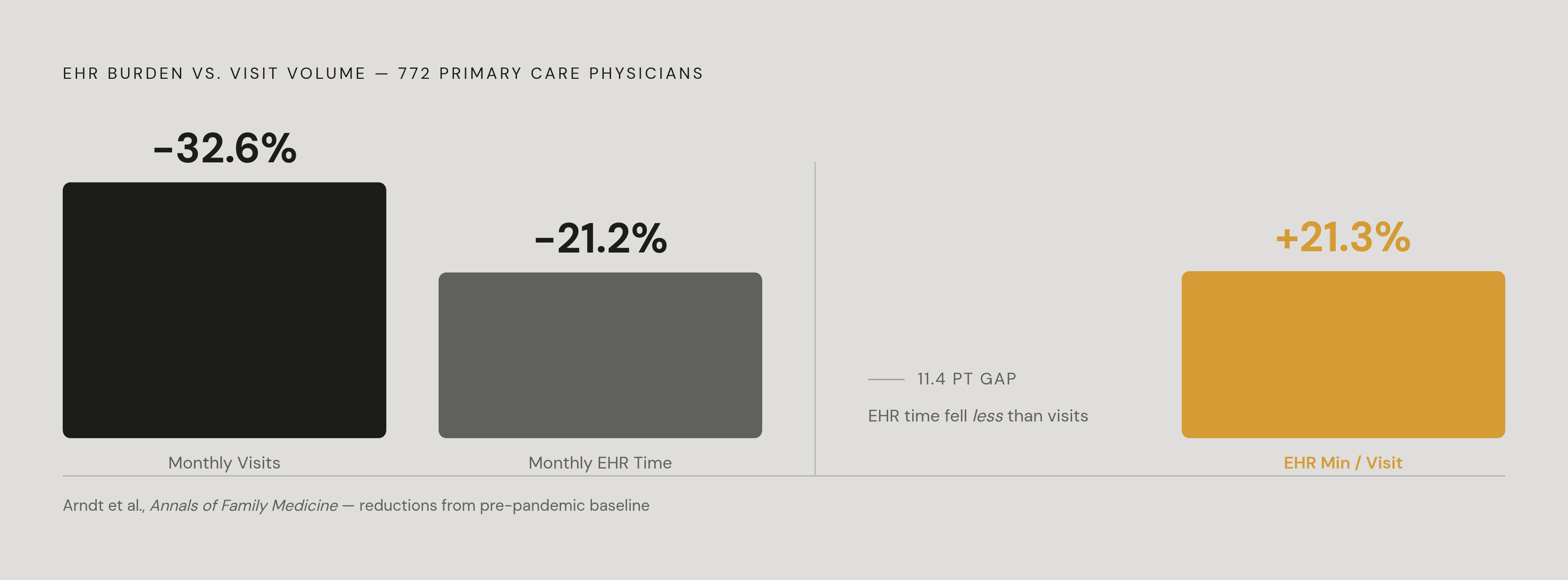
EHR task queues overflow in high-volume primary care for a specific reason: the categories, the routing rules, the whole logic behind what gets prioritized, got built for a pace of work that doesn't exist anymore. A study by Arndt et al. in the Annals of Family Medicine tracked 772 primary care physicians who cut their monthly visit volume, and the finding should bother anyone who assumes fewer patients means less paperwork: visits fell 32.6%, but EHR time dropped only 21.2%. That gap pushed EHR minutes per visit up 21.3%, and electronic messaging per visit climbed too, while the patients who stayed on those trimmed panels turned out to be sicker and harder to manage, which tells you administrative load doesn't track visit count at all. It has its own drivers, and those drivers live inside how the queue gets built. You can see the downstream effect in access numbers: the average wait for a family medicine appointment now runs 20.6 days, per NASEM's citation of Jabbarpour's 2024 work, and a chunk of that delay traces back to physician time getting eaten by paperwork instead of patients.
How EHR task queues are structured and where that structure breaks down at scale
A task queue in a primary care EHR is a catch-all. It grabs everything that didn't get resolved during the visit itself: refill requests, lab results, referral responses, prior auth follow-ups, portal messages, billing flags. Somebody set up the categories and routing rules back at go-live, and in most practices nobody has touched them since, even as visit volume shifted, payer mix changed, and the patient panel got older and sicker.
The routing logic tends to be flat. Tasks get assigned by role, physician, nurse, front desk, rather than by urgency or by how much work resolution actually takes. A prior authorization appeal that eats forty-five minutes of back-and-forth with a payer sits in the same queue as a fax confirmation that takes ten seconds. Neither gets its own lane, and nothing tells whoever opens the queue which item needs real thought and which needs a glance and a click.
Then there's the intake screening problem. EHRs keep embedding standardized questionnaires into every visit workflow, often tied to performance metrics rather than anything specific to that patient, and each one throws off a queue entry (Simon, 2023, cited by the AMA). None of it distinguishes between a task that needs a physician's judgment and one a trained non-clinical staffer could close in the same five minutes. So physician queues fill up with work well below their scope, and the compounding starts: tasks age, aging triggers secondary notifications, notifications become new tasks. The queue starts generating its own overflow, independent of how many patients actually walked through the door that week.
The human workarounds practices already use and what they reveal about queue design flaws
Practices have noticed the problem, even without naming it correctly.
"Task buddy" systems, where pairs of providers cover each other's queues to spread out volume, show up everywhere. A 2025 PRiMER study tracked average task age and the number of late tasks before and after one such system launched, and found real short-term improvement that mostly faded by the six-month mark. That fade suggests the fix touched throughput rather than the routing logic that put the wrong tasks in the wrong queue to begin with, since speeding up how fast two people process a badly sorted pile doesn't fix the sorting.
Senior staff often step in to triage by hand, sorting tasks before they reach a physician's queue at all. The instinct is sound, but the scale is wrong, and it just moves the bottleneck to whoever's doing the sorting, who becomes the new constraint the moment they call in sick or get pulled onto something else.
Then there's after-hours batch processing, physicians clearing queues once the clinic empties out, which the Health Affairs data confirms rose among the physicians who cut their visit volume. That rise suggests the queue isn't getting resolved during the hours it's supposed to be resolved in.
Residency programs feel this hardest. Rotating providers, inconsistent schedules, and training obligations stacked on top of clinical duties make informal workarounds especially brittle, which is part of why PRiMER looked at that setting in the first place. Across every one of these fixes, practices keep throwing human effort at a structural problem instead of fixing the structure itself.
Diagnosing a practice's queue before redesigning it
Before touching a single routing rule, a practice needs answers to a few questions. What share of queue items actually need a physician's clinical judgment, versus an administrative action a staff member could take on their own? Which task categories sit unresolved the longest, and is that delay concentrated in particular routing destinations? Which task types keep coming back, a sign they got resolved incompletely the first time? And how much of the queue volume traces back to intake screening tied to performance measures rather than to something a specific patient needed that day?
Most EHR platforms already log the metadata needed to answer this: task creation time, assignment, resolution timestamp, the same kind of longitudinal data the Health Affairs researchers pulled to track those 772 physicians.
One pattern is worth hunting for specifically: tasks that show up constantly and get closed out the same way almost every time. That's high volume paired with low variance, and those are the automation candidates, whoever currently handles them. The opposite pattern, low volume but high effort, like prior authorizations or complex denial appeals, points to a routing problem instead. Those need a dedicated lane, separate from a shared pool where they'd otherwise lose out to routine items competing for the same attention.
The line between a routing problem and a staffing problem comes down to consistency. A task type that stalls no matter who it's assigned to means the bottleneck is built into the structure, while one that only stalls when a particular role is short-staffed is a capacity issue, and no amount of queue redesign fixes that.
Redesigning queue categories and routing logic to match clinical pace
A few principles hold up across most redesign work we've seen practices attempt.
Segment by how hard a task is to close, not by task type. A practice needs distinct lanes: same-day clinical decisions, same-day administrative completions, and multi-day workflows like prior auth and appeals. That third category needs a dedicated owner and a stated turnaround expectation, because mixing it into a shared pool with same-day items means it always loses the fight for attention, since same-day items feel more urgent even when they aren't more important.
Route every task to the lowest-scope role capable of closing it out completely. Most refill renewals for a stable medication on an established patient don't need a physician to initiate anything; they need a protocol and a trained staff member who can execute it. Physician queues should surface only the work that genuinely requires physician judgment, because that's the practice's scarcest resource, and protecting it is the entire point.
Audit what's generating the intake in the first place. Screening driven by performance metrics adds volume without adding proportional clinical value in every case. A real audit checks how often a given screen actually changes a care plan against how many queue entries it throws off. Where documentation gaps at the point of care are what's triggering downstream tasks, fix the documentation workflow at the source instead of stacking another queue entry on top of it.
Build team-based documentation into the routing structure itself. Research into team-based care models has found that spreading documentation responsibility across a care team cuts per-physician EHR burden. The structural version of that finding: route documentation-adjacent work, chart prep, filing results, to team members before it ever reaches the physician's screen.
None of this is a one-time fix. Payer mix shifts, new performance measures get added, staffing models change, and routing rules that made sense eighteen months ago stop making sense. Queue setup needs a review cadence, same as fee schedules or clinical protocols.
Where automation fits into queue management and what it can realistically handle today
The categories flagged earlier as high-volume and low-variance, prior auth status checks, claims submission, referral intake, routing results to the right recipient, are exactly where automation does real work today.
Computer-use agents mark a real shift in how that automation gets deployed. These agents work the existing software the way a staff member would: reading the screen, clicking through the same interface, typing into the same fields. That means they run on top of legacy systems without a workflow overhaul. The technical approach has moved toward vision-based perception, reading the screen the way a person reads it, replacing older methods built on HTML or accessibility trees, and that shift made these agents noticeably more reliable on the dense, cluttered screens EHRs are known for.
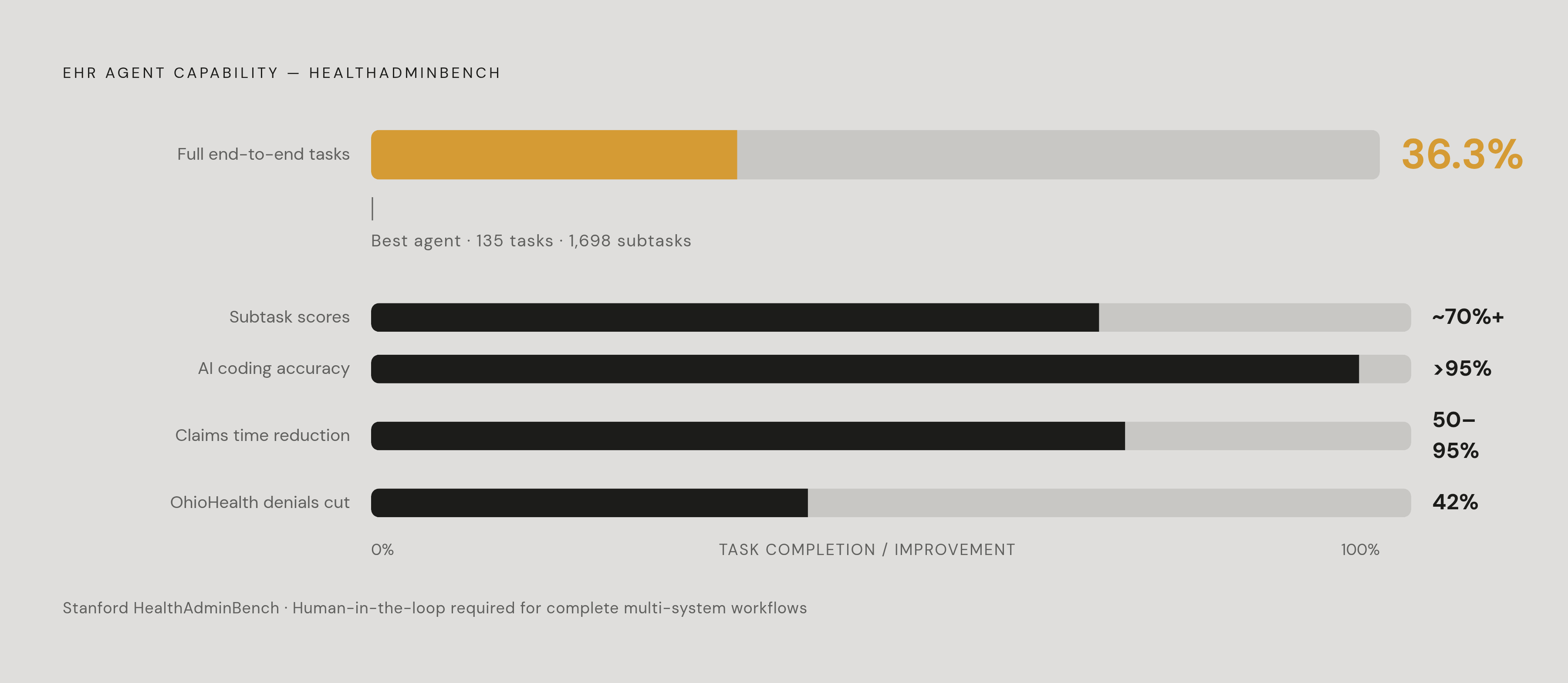
The evidence on current capability deserves a plain look. Stanford's HealthAdminBench is the first real benchmark built to test computer-use agents on EHR administrative work: 135 expert-designed tasks spanning prior authorization, appeals and denials, and DME order processing, broken into 1,698 subtasks for granular scoring. The best agent tested finished full end-to-end tasks successfully 36.3% of the time. Individual subtasks score meaningfully higher, but stringing together a complete multi-system workflow without a human stepping in is still an emerging capability, and agents do best on bounded, well-defined pieces of a workflow, covering only part of the process today.
Outside research settings, the results already on the ground are concrete. AI-assisted coding tools report accuracy above 95% in vendor studies, and organizations running claims automation report processing time cut by 50% to 95%. OhioHealth cut denials by 42% using Experian Health's Patient Access Curator, catching claim errors at intake instead of after the fact, an upstream fix that shrinks queue volume before it ever forms downstream. In referral processing, AI agents handling referral processing tasks such as fax transcription, chart creation, and insurance verification have meaningfully reduced manual processing time in documented deployments. Ambient documentation tools, Elation Health's suite among them, save clinicians an average of 12 minutes per visit, which adds up to roughly two hours a day at typical primary care volume, and that pairs naturally with queue redesign, since it cuts the documentation tasks that would otherwise land in the queue in the first place.
For practices that can't justify a custom integration project, agents built to run on any EHR without that requirement, Novoflow being one platform that operates a practice's existing EHR through screen-based agents rather than integrations, matter a lot. Going live in weeks instead of months means staff capacity doesn't take a hit during the transition. HIPAA compliance and SOC 2 Type II certification are the baseline requirement for any agent touching PHI inside a queue workflow, not optional, not negotiable.
What a redesigned queue actually changes for staff and patients
A queue sorted by how hard a task is and who should own it means a physician's clinical judgment gets spent where it's needed, not burned on a fax confirmation.
Administrative staff benefit too, in a more mundane but no less real way: routing tasks to the lowest-scope qualified role means people work at the level they trained for, instead of sitting on a task waiting for a physician to sign off on something they could have closed an hour earlier themselves.
The revenue cycle sees it differently. Catching claim errors before submission, tracking prior auths through dedicated lanes instead of a shared pool, and routing denials into structured appeals workflows all cut down on the rework that piles up, claim by claim, across a full schedule.
Patients feel it last, but they feel it. The 20.6-day average wait for a family medicine appointment is partly a capacity problem, and capacity gets used up by administrative work that a properly redesigned queue would route away from physicians entirely, so protecting clinical time has a direct, measurable effect on how fast a patient gets seen.
None of this solves panel size, payer complexity, or workforce shortages. Those are real constraints, and queue redesign doesn't touch them. What it does is stop those constraints from getting worse because of administrative friction that never needed to exist in the first place. The number worth watching isn't how many tasks a queue processes in a day. It's how many hours of physician and staff time go toward work that actually required their specific role to finish, and whether structural redesign moves that number in the right direction.