Timely Filing Deadlines by Major Commercial Payer
Missing claims in the worklist create silent delays that blow past deadlines before anyone notices.

CO-29 means the payer got your claim after the deadline, full stop. No appeal fixes that. Timely filing windows run anywhere from 90 days to a full year depending on payer, plan, and sometimes state, and the clock starts on the date of service, not the date someone in billing finally opens the chart. I've watched practices lose five-figure months to this single denial code, and almost none of it was clinical. It was scheduling. A coding error can be fixed, but a late claim cannot, and the informal leniency payers used to extend for a borderline-late submission is mostly gone now, replaced by mechanical, systematic enforcement that doesn't care how good your excuse is.
This piece walks through where the actual deadlines sit across Medicare, the big commercial payers, and Medicaid, how CO-29 denials actually happen inside a billing operation, and what stopping them really takes.
Medicare's 12-month window and its most misunderstood exception
Medicare is the simplest rule in this article and also the least forgiving one. Claims must land within 12 months (365 days) of the date of service, with no grace period and no discretion. Day 366 gets denied automatically, and the reason code that comes back doesn't leave room for negotiation.
The exceptions are narrow enough that most practices will never touch them. CMS recognizes documented administrative error on its own end, and retroactive Medicare entitlement (meaning a patient becomes Medicare-eligible after the visit already happened). Provider oversight doesn't qualify, and neither does a busy front desk, a backlogged coder, or a biller who took two weeks off and came back to a pile. If the delay started on your side of the transaction, the 12-month rule does not bend for it, and nobody at Medicare is going to pretend otherwise.
Here's the exception that actually trips people up, and it isn't really an exception. It's a different starting line for the same race. When Medicare is the secondary payer, the 12-month clock runs from the date on the primary payer's Explanation of Benefits, not the date of service. For a practice with a mixed payer population, that means two claims from the same visit, same patient, can be running on two completely different timelines. A biller who defaults to date-of-service tracking on every claim will get the secondary claim's real deadline wrong, every single time coordination of benefits is in play.
Take a visit from June 1. Staff turnover, which happens in every billing department eventually, leaves the claim sitting unsubmitted, and it finally goes out June 10 of the following year, nine days past deadline. Automatic CO-29, no appeal path, full charge, gone. Nine days is the entire margin between getting paid and writing the whole thing off, and it's the kind of gap a distracted worklist creates without a single alarm going off until the denial lands.
Filing deadlines for major commercial payers in 2025–2026
Commercial payers don't run on one number, and treating "the deadline" as a fixed fact about any given insurer is exactly where billing teams get burned. The same company can carry three different windows depending on whether the plan is employer-sponsored, sold on the ACA marketplace, or structured as Medicare Advantage.
Aetna's standard commercial window is 120 days from date of service. Employer-sponsored and Medicare Advantage plans under Aetna can stretch that to 180 days, sometimes a full year, depending on what the specific plan document says, and it really is worth pulling that document rather than assuming.
Cigna generally sits at 90 to 180 days across its commercial book, though certain employer plans go out to a year. UnitedHealthcare follows roughly the same shape: commercial plans in the 90-to-180 range, Medicare Advantage and employer-sponsored UHC plans stretching to a full year. Humana is the outlier on the short end (90 days standard, across the board, no exceptions I've seen). Any practice carrying real Humana volume should treat that 90-day mark as a hard internal stop, not a target to aim near.
Blue Cross Blue Shield resists a clean summary entirely, because BCBS isn't one company's rulebook, it's dozens of state plans each setting their own timely filing rule. The general range is 90 to 180 days, but that range is not something you can bill against; individual BCBS plans differ enough that a biller working off a national average will guess wrong on a meaningful share of claims. This is the one payer on the list where "verify once and file it away" just doesn't hold, so check the local plan contract directly, every time.
The broader trend across commercial payers has been toward shorter windows, not longer ones. Ninety days is becoming the effective floor for most plans regardless of what the stated maximum says on paper, so the practical move is to treat 90 days as your internal trigger point for any unresolved commercial claim, no matter who's holding it. Waiting until a claim nears its stated maximum is waiting too long, and payer websites and provider guides are starting points, not contracts. The plan contract governs, contracts get renegotiated, and a reference list nobody's audited in the past year is a liability, not an asset.
Medicaid timely filing: why state variation makes a single answer impossible
Medicaid has no federal equivalent to Medicare's 12-month rule. Every state sets its own window, and the range runs from fairly tight to well over a year depending entirely on which state program you're billing.
States also change these windows, sometimes mid-year, in response to whatever administrative pressure is hitting them that quarter. Ohio extended its Medicaid timely filing deadline to March 1, 2025, specifically to give providers relief while the state's managed care transition was causing contracting chaos. California extended certain Medi-Cal windows to 12 months around the same period, while other states moved the opposite direction across 2024 and 2025, tightening rather than loosening. There's no single trend line here. Policy moves both ways depending on the state, and any practice assuming Medicaid rules only ever get more generous is going to be wrong somewhere in its payer mix, probably sooner than it thinks.
Managed Medicaid stacks a second layer of variation on top of the state rule. MCOs set their own timely filing limits, and those limits can differ from the state's fee-for-service window even inside the same state program. A practice billing both traditional Medicaid and a Medicaid MCO in one state can be running two different clocks under what looks, on paper, like the same program name.
Prior authorization timing feeds into all of this in a way that's easy to miss. CMS requires Medicare Advantage and Medicaid managed care plans to issue prior auth decisions within 72 hours for urgent requests (seven calendar days for standard ones). Faster authorization means the service date, and the filing clock attached to it, arrives sooner than it used to. A practice that's slow on the back end, slow to submit once authorization clears, is quietly shrinking its own runway without noticing. The fix isn't complicated in concept: keep a state-by-state reference for every Medicaid program you bill, and update it the moment a state announces a change rather than finding out through a denial three months later.
How CO-29 denials happen and what it actually takes to appeal one
CO-29 is the code for "time limit for filing has expired." It shows up on the EOB or Remittance Advice, and functionally it means the payer already decided it won't reconsider payment. You don't talk your way out of this one with a phone call, however good the story is.
Most CO-29s aren't accidents. They're process failures that repeat until somebody actually fixes the process instead of the individual claim. Wrong patient details or mismatched procedure codes force internal rework that eats straight into the filing window. Missing documentation (a SOAP note that never got finalized, a prior auth letter still sitting on the referring office's desk) holds a claim in queue past its deadline. Staff turnover strands claims in somebody's worklist with nobody assigned to pick them back up. Coordination of benefits confusion, billing the wrong payer first and restarting the whole process, burns days you don't get back. And, as covered above, tracking a secondary payer's clock from the date of service instead of the EOB date is one of the most common, and most avoidable, sources of a CO-29 in any practice with real Medicare secondary volume.
Appealing a CO-29 is possible under a narrow set of conditions, and the burden of proof sits entirely with the provider, not the payer. A successful appeal generally needs a clearinghouse acceptance report with timestamps and claim IDs, or a payer portal confirmation showing the exact date and time of submission, proving the claim actually went out on time and something broke on the payer's end. It also needs documented evidence of a payer-caused barrier: a portal outage, a system error, an administrative mistake on their side. A well-written narrative letter without that timestamp, no matter how sympathetic, rarely moves a CO-29. For the majority of these denials, where the claim genuinely wasn't submitted on time, there's no appeal path at all. The revenue is just gone.
The financial weight extends well past any single claim. More than 10% of U.S. hospital claims get denied overall, and denials nationally now cost hospitals over $20 billion a year. Timely filing sits inside that total as one of the more preventable categories precisely because the failure isn't clinical, isn't even a coding problem; it's a scheduling failure, plain and simple. And where the average rework cost of roughly $25 per denied claim applies to categories where rework is actually possible, CO-29 offers no rework option at all, only the write-off.
The workflow gaps that turn missed deadlines into a pattern rather than an exception
The 2025 State of Claims survey found 54% of providers saying claim errors were increasing, and 32% pointed to inaccurate or incomplete patient data at intake as a primary driver. That intake problem compounds fast: an error kicks the claim back, it gets reworked, resubmitted, and each pass through that loop burns days against a deadline that isn't moving to accommodate you.
Worklist management is where this stops being incidental and starts being structural. Pending claims sit in queues with no visibility into how close they are to expiring, so billers often don't know which ones need attention until it's already too late to act. Staff turnover compounds it further, as claims in progress get orphaned, unassigned, and sit until someone happens to notice, usually after the deadline's already passed.
Multi-payer complexity makes all of this worse by default. A practice billing Aetna, UHC, Humana, BCBS, and Medicaid at once is juggling at least five different timely filing windows, probably more once plan-type variation inside each insurer gets counted. A single blanket policy (submit within 60 days for everything) ends up too conservative for some plans and dangerously tight for others, especially the 90-day payers, the moment any delay creeps in.
Secondary payer errors follow a pattern you could set a watch to: bill the primary on time, the primary takes its sweet time processing, and then the practice submits to the secondary based on the original date of service instead of the EOB date, filing past the secondary's real window without anyone noticing. Documentation bottlenecks add one more failure point on top, since claims waiting on provider notes or authorization letters just sit until the missing piece shows up, sometimes after the door's already closed.
None of this is random. These are the predictable, repeatable consequences of running a fragmented payer landscape through manual, calendar-blind workflows, and I've yet to see a practice that fixed it by just asking staff to be more careful.
How automation reduces timely filing denials and what current AI tools can and cannot do
The real value automation offers here is closing the gaps where claims sit idle between steps: intake, coding review, authorization, submission, secondary billing. Every handoff is a place a claim can stall, and every stall eats into a deadline that doesn't care how busy the office was that week.
There's real evidence this works at scale. AI-enabled revenue cycle tools have demonstrated meaningful improvements in first-pass approval rates by catching errors before a claim ever reaches the payer, and the CAQH 2024 Index put the industry-wide savings opportunity at $20 billion a year just from moving manual administrative transactions to fully automated workflows.
Computer-use agents are the newer piece of this. These systems interact with EHR screens and payer portals the way a human biller does (reading a screen, clicking a button, typing into a field) rather than needing a direct data connection into the payer's backend. That matters specifically for timely filing because most payer portals don't expose an API; human-like interaction with the interface is often the only route in. An agent like this can, in theory, monitor a worklist, flag claims approaching deadline, and submit through a portal on a fixed schedule regardless of staffing or office hours.
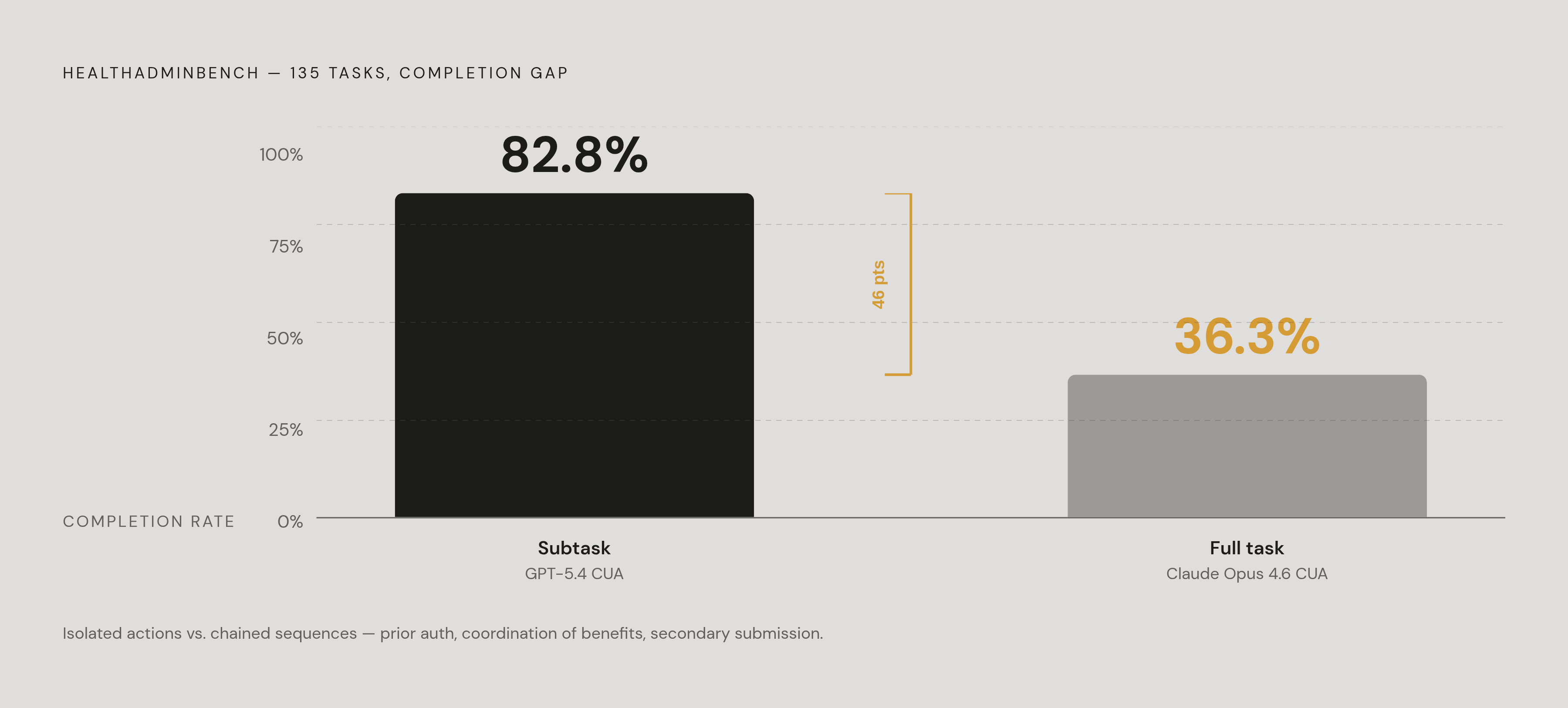
The technology is promising, but it is not yet reliable end to end, and anyone telling you otherwise is selling something. The HealthAdminBench benchmark tested computer-use agents against 135 expert-designed healthcare administrative tasks across simulated EHR and payer portal environments. Best full-task completion rate: 36.3%, from Claude Opus 4.6 CUA. Best individual subtask rate: 82.8%, from GPT-5.4 CUA. That gap is the whole story: agents are good at individual actions and much less reliable stringing a long sequence of them together without a slip. The hardest failure points were document handling, coordinating across multiple portals, and holding state over many steps, which is exactly what a claim needing prior authorization, coordination of benefits, and secondary submission demands.
Real-world conditions add friction the benchmark doesn't fully capture, either: multi-factor authentication prompts, CAPTCHAs, session timeouts, portals that change their screen layout without warning and break an agent tuned to the old one. What that adds up to is a fairly clean division of labor. Automation handles high-volume, repeatable work well (routing clean claims, watching submission queues, flagging approaching deadlines), while complex multi-step claims still need a human somewhere in the loop.
Even so, a large majority of healthcare executives rank automation and AI as their top revenue cycle investment priority for the next 12 months, and that number isn't going to shrink. Practices that wait are going to keep bleeding on the preventable denial categories, timely filing chief among them, that automation is best built to catch before they happen. For practices that can't take on a long integration project, platforms built around computer-use agents that skip the EHR API requirement, and that can go live in weeks rather than months, are becoming a genuinely realistic option. Novoflow, a Y Combinator-backed healthcare AI startup, is one example, deploying agents that operate a practice's existing EHR without API integrations.
A practical system for tracking and enforcing deadlines across your payer mix
Build a payer reference that belongs to your practice, not a generic industry guide. Use the numbers in this article as a starting point, then pull every active payer contract you hold and record the timely filing limit verbatim from the contract language, not from the payer's website. Contracts get renegotiated, and websites don't always keep pace with the paper that actually governs the relationship.
Set internal submission targets well inside the real deadline, never at its edge. For 90-day payers (Humana and much of UHC and Cigna's commercial book among them), a 30-to-45-day internal target from date of service gives you a real buffer against the kind of nine-day miss that turns into a full write-off. For 120-day payers like Aetna standard commercial, that target can stretch a bit further, but the logic holds: the internal deadline should always sit meaningfully short of the contract deadline, never equal to it.
Track secondary payer clocks separately from primary ones, and trigger the secondary countdown from the EOB date, not the date of service. That one change closes off one of the most common, and most avoidable, sources of CO-29 in any practice with a mixed Medicare and commercial population.
Audit the whole reference list on a fixed schedule, at minimum once a year, and treat any state Medicaid announcement or contract renewal as an immediate trigger to update it. Deadlines in this business don't stay put, and a practice's defense against losing clean revenue to a CO-29 denial is only as good as the last time someone actually checked whether the numbers on the sheet are still true.